
info[at]ictm.ie
info[at]ictm.ie
Irish traditional music holds within it many pieces. It holds Ireland's background throughout history, their culture, and even their ever-changing social values. From an Irish common hearth to even a stage, whoever moved those sounds carried stories from their time. Gender-related issues have always weighed in on who performed, who taught, and who got recognition for it. With the musicians now blurring some of those old lines, this interaction of voice within Irish music shall keep on evolving.
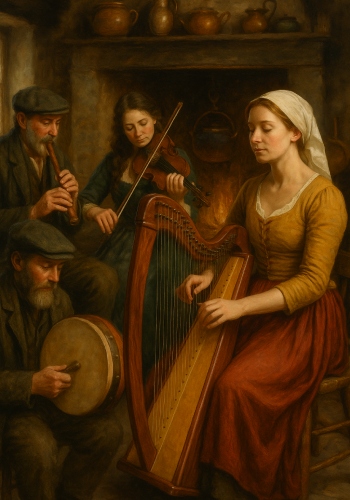
Through much of Irish history, music has been used internationally as a social force-the development of music intertwined with the commercial life and other functions of the community. Yet, gender roles tended to dictate how and where people made music: men would do so in public places, while women played instruments and sang at home. Cultural prescriptions almost immortalized barring women from sessions, contests, and touring groups-despite their skills on par or often better than those of male musicians.
The music was nurtured in homes and at smaller gatherings before Irish tunes had come into wider public cognizance through radio-dissemination and recording. Women were at the center of the scenes' nurturing of the younger generations and the inheritance of local styles. Yet scarcely did their names find any place in older traces of musical history.
In rural Ireland, several women took upon themselves to act as music teachers to their own families. They sang lullabies, passed down old ballads, and fostered the tradition of oral culture. Their music was full of heartfelt emotion and storytelling, usually aligned with ordinary human activities. These songs would give identity to a region or express a language, especially in Irish-speaking areas.
It rarely got recorded since it was entertainment held in private. In the 20th century, collectors and ethnomusicologists would usually confine their selections of men as the representatives of the tradition in their field recordings. As a result, the women who influenced and guided their earliest musicians remain largely nameless.
Throughout the greater course of history, women had many constraints imposed upon them, even though they did and sometimes did capture a bit of limelight. Musicians went out there with an intention every day to defy social conventions through their public performances: Elizabeth Cronin was a singer from Cork, and Julia Clifford was an instrumentalist from Kerry. From here, new precedent was given to be built upon by all generations in the range of professions. It opened a path that proved musicianship stood above gender roles and that women have always been there in the Irish music tradition, irrespective of whether history remembers their names or not.
By the latter portion of the twentieth century, Irish traditional music began to mirror the social and cultural changes in the transforming Ireland. More and more women began to enter performance, composition, and leadership domains as education was increasingly becoming more accessible and feminist movements gained momentum. Presently, women are the equal counterparts of men in festivals and sessions as singers, instrumentalists, and teachers, as well as in organizations of the new generation of Irish music. Besides innovation, Sharon Shannon, Liz Carroll, and Moya Brennan have also changed the very sound of the tradition; younger artists have been duly encouraged to approach instruments that were once forbidden to them as women.
While still subtle discrimination lingers, equality and visibility are discussed more openly now than ever before. Projects of recording women-attested contributions are doing much to set the record straight and honor their artful advancements. Thus, by way of acknowledgment, Irish traditional music will continue to grow not just in culture but further towards social progress and inclusiveness.
In this story about gender and Irish traditional music, we see the reflection of the larger Irish society. What started as male-dominated public art became co-domain. Women have always been there: keeping the songs alive, teaching, and performing while history ignored them. Today, ones whose voices were once subdued go everywhere-the sessions, the classrooms, and the stages all over Ireland. The tradition grows stronger because now it reflects the full richness of the people that carry it forward.
Subscribe Our Newsletter
Copyright © ictm.ie, 2026. All Rights Reserved.