
info[at]ictm.ie
info[at]ictm.ie
Music has always been more than what one listens to. Across Ireland and beyond-the lands of Ireland-music has acted as a medium of expression through stories, identities, protest, and communion. To understand music in an orthogonal setting-therein lies the reason why certain types of tunes survive-and this intertwines very much with how communities develop their sound over time.
This page does central research into rubbery ties between music, culture, and society, pondering how they-values, identity, and change-reflect melodies.
No society is ever indifferent to the music it nurtures. And the rhythms, lyrics, and instruments of traditional Irish music have a lot to tell us about Irish life: about its hardships, about its humour, about its faith, and about its resilience. From laments remembering famine and emigration to vibrant reels witnessed by village halls, every piece of music marks a particular time in Ireland's social history.
With émigrés and political tensions carving life in the 19th and early 20th centuries, songs became cries of resistance and emotive responses to land issues, emigration, and identity; they were land, emigration, and identity oral folk commentaries. Present-day music continues reflecting on Irish life, tackling issues such as equality, diaspora, and cultural maintenance.
Music has long been a way for people to affirm their identity and place of origin. In Irish communities, traditional music passes down from generation to generation to develop a sense of belonging. However, in diaspora communities, session will be held at a pub or cultural center from Boston to Sydney, allowing the generation far from home to reconnect through familiar tunes.
So music is a kind of anchor and bridge. It helps to conserve language, customs, and memories, while at the same time allowing the culture of Ireland to enter the world at large through collaboration and adaptation.
Music becomes an agent for social change. Folk and protest songs have confronted injustice since the Irish independence era. Contemporary artists address global issues, migration, equality, and the environment through sound-a universal language.
Even in traditional circles, contemporary compositions reflect new ideas of gender, politics, and identity. And the society that carries these ideas in itself is in constant motion-the music remains in motion with it.
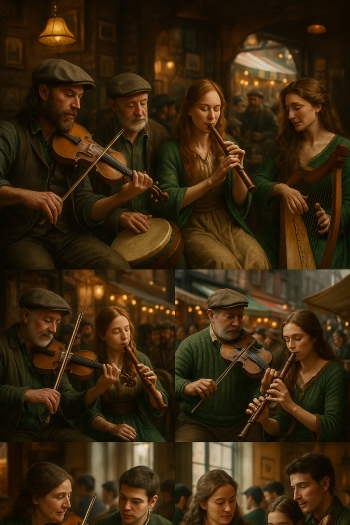
Culture is strongly shaped by music. It provides stories, values, and emotions to memories across time, making it both a record and a celebration of the human experience. Irish traditional music is, therefore, ingrained in its culture. It is present at festivals, dances, wakes, and milestones, uniting people through shared memory and participation.
Since music can only be experienced collectively, it becomes a cultural glue. At a local session, hinting the participation of a living tradition arises as both the applause and the playing of a fiddle or bodhrán come literally from the hands of all listeners and players alike.
Teaching traditional music has become one of the pillars of cultural preservation. Organisations, schools, and community groups all over Ireland teach children how to play music and explain to them the history behind a tune. In this way, the music remains a living and ever-changing expression of culture instead of a museum piece.
Through organisations such as Comhaltas Ceoltóirí Éireann, Irish Traditional music continues to prosper from generation to generation and across borders. Each lesson keeps the stories and social context that go with the meanings alive.
In many Irish towns, music is one way in which the threads of life are woven. Pubs, street markets, and festivals still resonate with reels and jigs from yesterday as much as from today. Sometimes, these events help people remember that in all actuality, melodies are more than art- they are an expression and a very real connection between people; a common language with which to communicate across class, age, and social aptitude.
The social function of music has now almost entirely disappeared, barring the few opportunities that technology is giving: enable the towns to build a common core of shared and preserved tunes online, at one end of the scale, and most significantly, keeping alive the intimacy with which their traditions have grown at the other.
Besides culture and history, music has deep effects on feeling and consciousness. Studies show its ability to reduce stress, to cultivate empathy, and to promote social cohesion. The Irish music system is capable of conveying all emotions that humanity can ever muster-gloomy tunes or merry dances.
This moment of connection arises precisely as much in a concert hall as in a kitchen while a piece is being performed or in the presence of another person.
Subscribe Our Newsletter
Copyright © ictm.ie, 2026. All Rights Reserved.